Four common relationship patterns that keep couples stuck
How gay couples can recognize the cycles that drive them apart and learn to reconnect through Emotionally Focused Therapy.

Few things are more discouraging in a relationship than having the same argument over and over again. The topic may change, but the conversation follows a familiar trajectory, leaving both partners feeling frustrated, misunderstood, and alone. Over time, these exchanges can erode affection, diminish sexual intimacy, and create a sense of hopelessness about the relationship. Some couples eventually stop arguing altogether, with both partners giving up on being understood.
What's especially painful is that both partners genuinely love each other, yet neither understands why their attempts to improve things seem to make them worse.
Understanding negative cycles
Emotionally Focused Therapy (EFT) is an approach to couples therapy based on attachment theory, which recognizes our fundamental need for emotional connection and security in close relationships. EFT helps couples identify recurring interaction patterns, called negative cycles, in which each partner's response to distress unintentionally provokes the very behavior they find most upsetting in the other.
These patterns are common across sexual orientations. They aren't necessarily signs of an unhealthy relationship. Even happy couples tend to have characteristic ways of responding to conflict. Problems develop when these responses become rigid, repetitive, and increasingly difficult to escape.
Do you recognize your relationship?
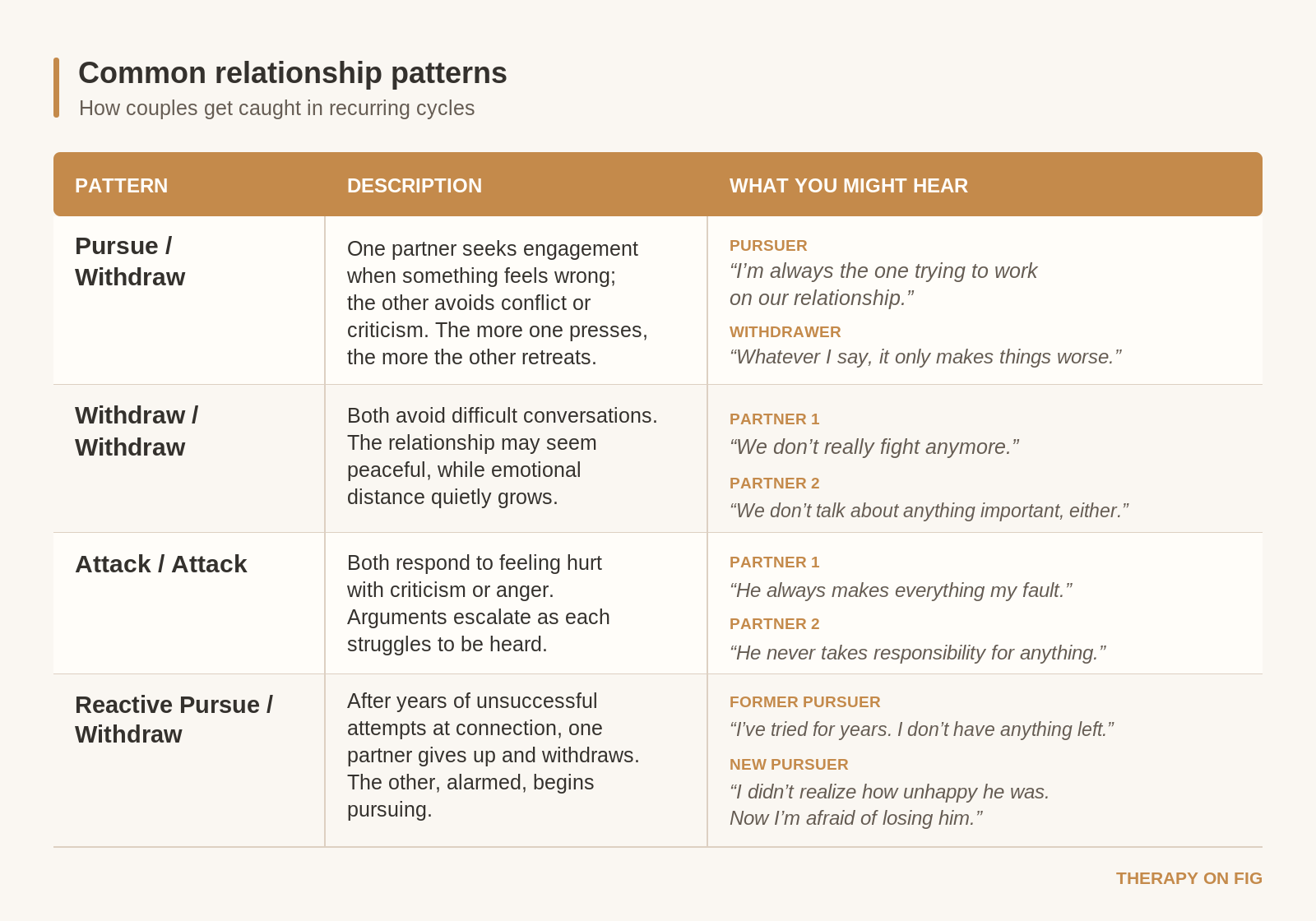
EFT identifies 4 several common patterns that couples develop when they experience tension or emotional distance. The most common pattern is pursue/withdraw. The pursuing partner often initiates conversations about the relationship, hoping to resolve problems, restore closeness, or address a growing sense of distance. When these efforts seem to go nowhere, he may become increasingly frustrated, critical, or demanding. Beneath his frustration is a longing for connection and a wish to be reassured that he matters to his partner.
The withdrawing partner may be equally aware that something feels off, but approaches the difficulty quite differently. He may dread conversations that tend to end in criticism, blame, or disappointment. To avoid making things worse, he may try to keep the peace, explain himself, offer practical solutions, or simply go quiet. Beneath his withdrawal may be a fear of conflict, a sense of helplessness, or the painful feeling that whatever he does will never be enough.
Both partners are responding to genuine distress, yet the more one presses for engagement, the more the other retreats. Each person's efforts to manage the situation reinforce the very behavior that troubles them, leaving both feeling increasingly misunderstood and alone.
What's happening beneath the argument?
One of EFT's central insights is that the emotions we express during conflict often conceal more vulnerable feelings that are difficult to recognize, much less share.
A pursuing partner may be acutely aware of his anger or loneliness but not the fear he feels when his partner seems far away, or how much he longs to know that he's still wanted. A withdrawing partner may feel criticized, pressured, or exhausted by repeated discussions, yet struggle to identify the discouragement, uncertainty, or fear of disappointing his partner that makes these conversations so uncomfortable.
Our responses to conflict are shaped partly by our earlier experiences of closeness, rejection, and emotional safety.

For gay men, growing up concealing important parts of ourselves, anticipating disapproval, or learning to manage difficult feelings alone may also influence how we approach intimacy in adulthood.
When we begin to understand the feelings beneath our partner's behavior, we may discover that we've been misreading each other for years. What felt like cold indifference may actually be helplessness and a fear of making things worse. What sounded like relentless criticism may be a desperate attempt to reach us, to feel loved and wanted. The very behaviors that have driven us apart begin to reveal how much we matter to each other.
How EFT helps couples change their cycle
In EFT couples therapy, we start by identifying the pattern and helping both partners see how they participate in it. Rather than deciding who's right or wrong, we explore what happens between them. As the cycle becomes clearer, we turn our attention to the emotional experiences beneath these familiar reactions.
Understanding the cycle is an important first step, but lasting change requires new experiences with one another. Through guided conversations in therapy, partners begin expressing the feelings and needs that have been obscured by criticism, defensiveness, or silence.
A pursuing partner might discover that he can speak openly about missing his boyfriend without accusing him of neglect. A withdrawing partner may find words for his feelings of overwhelm or helplessness, learning to speak up for himself and express his needs rather than retreat into silence. As both partners become more open and responsive, they begin to experience one another differently, gradually replacing their old pattern with one that brings them closer.
Couples often come to therapy believing they need better communication skills. Yet as partners develop greater understanding of themselves and each other, communication often improves naturally. There is less need to defend, more room for curiosity, and a growing ability to discuss difficult feelings without threatening the relationship.
Building Lasting Relationships as Gay Men
Gay couples experience the same fundamental attachment needs as any other couple, although our personal histories may bring additional challenges. Many of us grew up without visible examples of enduring, emotionally intimate same-sex relationships, and some learned early that vulnerability or dependence on others carried risks.
Source: Furrow, J. L., et al. (2022). Becoming an Emotionally Focused Therapist: The Workbook (2nd ed.). Routledge, pp. 130–134.
Start working with an EFT couples therapist in Los Angeles
Couples therapy offers an opportunity to reconsider these old expectations and develop a relationship in which both partners feel more secure, understood, and able to be themselves.
No relationship is free of disappointment or conflict. What matters is knowing that when difficulties arise, we can turn toward the person we love, speak honestly about what's happening, and find our way back to each other. Reach out to schedule a free consultation.
Other services offered at Therapy on Fig
At Therapy on Fig, we provide therapy services tailored to the unique needs of couples, adults, and teens. We offer Neurodivergent Affirming Therapy, IFS Therapy, Therapy for Empaths, Trauma Therapy, Couples Therapy, Non-Monogamous Relationship Therapy, Teen Therapy, ADHD Therapy, Group Therapy, Therapy for Entrepreneurs, Anxiety Therapy, Therapy for Autistic People, Depression Therapy, Premarital Counseling, LGBTQ Affirming Therapy, and CPTSD Therapy. Whether you're seeking support for a specific issue or looking to strengthen your relationship overall, our therapists are here to help. Reach out today to learn more about our services!

Bret Hansen is an Associate Marriage & Family Therapist, #155624, supervised by Courtney Watson, LPCC, #21190. Trained in Emotionally Focused Therapy (EFT) and currently pursuing further certification in Level 1 Internal Family Systems (IFS), Hakomi Mindful Somatic Psychotherapy, and psychodynamic psychotherapy, he helps individuals and couples understand emotional patterns, navigate conflict, deepen intimacy, and build more authentic relationships with themselves and others.