
How lessons from non-monogamy can benefit monogamous relationships
A bookseller recently shared that they recommended the book “Polysecure,” a popular book on attachment and consensual non-monogamy, to many monogamous couples looking for guidance on improving their relationships. While the book was written by and for people navigating non-monogamy, its guidance on more secure relating, trauma-informed communication, and navigating jealousy is immensely helpful to monogamous couples. This has everything to do with the way dominant structures–monogamy, heterosexuality, cisgenderism, whiteness–thrive in unspoken expectations. When we name those expectations and ask whether they really work for us, we can become more aligned in our relationship with ourselves and others.
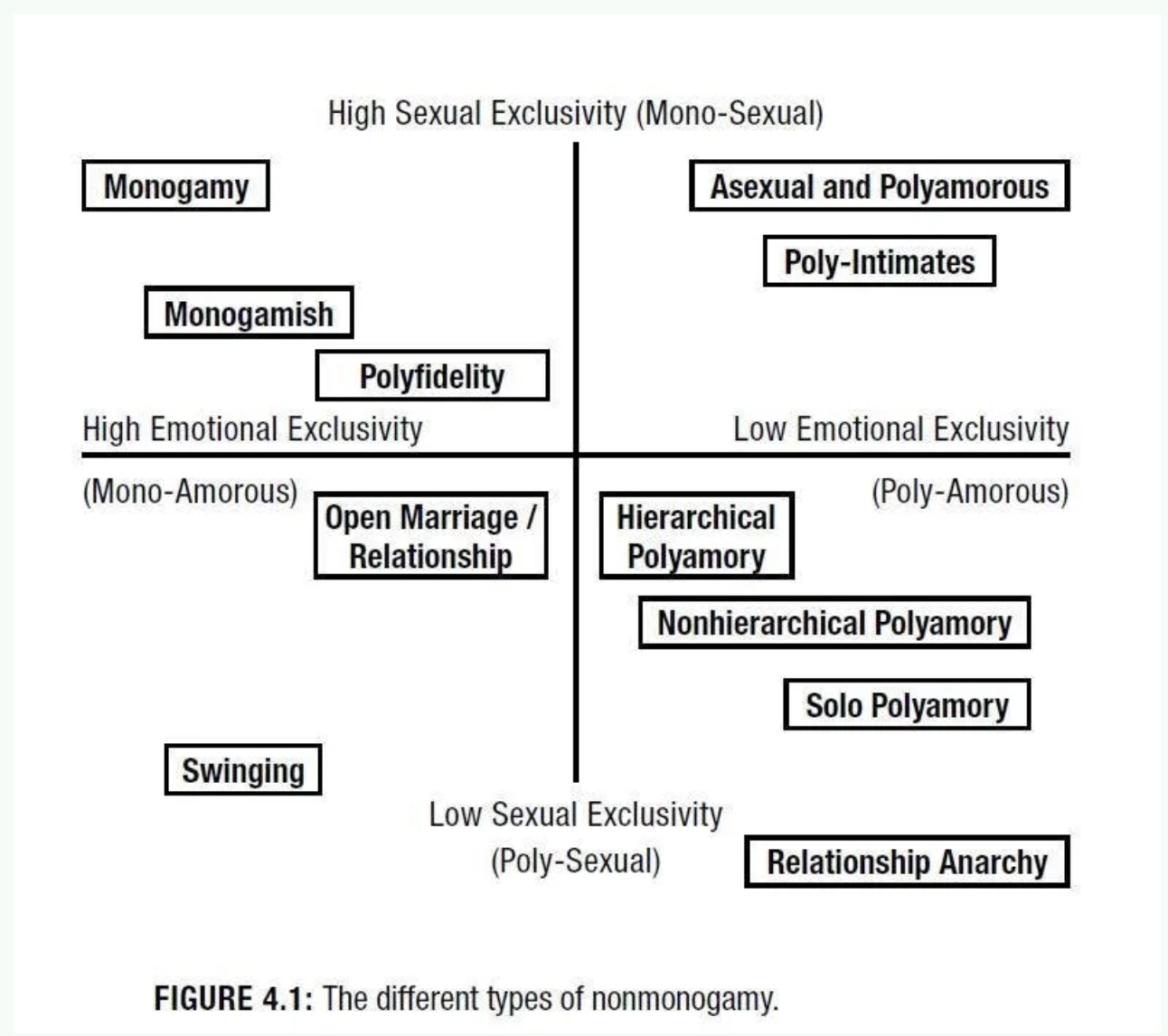
I find this true in another resource called “The Relationship Anarchy Smörgåsbord.” If we mapped relationship structures on a matrix of high to low sexual and emotional exclusivity [image on the right based on the book Polysecure by Jessica Fern and Neurodiverse Counseling], monogamy would sit in the top-left corner: emotional and sexual intimacy are focused on and prioritized for one person. As we travel down and across the matrix toward lower emotional and sexual intimacy, we’d pass open relationships, hierarchical polyamory, and at the complete opposite end: relationship anarchy. This relational orientation rejects any inherent hierarchy, meaning that romantic partners don’t automatically hold higher importance than friends, community, family, or self-care. All relationships are seen as valuable in their own way and are treated with the same level of care and consideration.
“The Relationship Anarchy Smörgåsbord” is a tool developed in community by polyamorous people over many versions that helps people decide what they want their relationship–any kind of relationship–to look like by breaking down all of the often unspoken potential elements into a kind of menu. Larger social/political categories (legal, financial, caregiving, exclusivity, power/hierarchy, systems of oppression) are in the outer circles and get more personal (sexual, romantic, domestic, emotional intimacy) moving inwards. Users are instructed to go through each category and its associated options, and to add any they think might be missing. For example, under “Public Displays of Affection,” users can choose from “Events, friends, family, work, social media, seen together.” The two people might be early on in their relationship and decide that they are only comfortable with PDA around friends, and will revisit the other categories at a later check-in.
A possible response to this process might be–” It’s not very romantic to list everything out like that/to talk about how systems of oppression show up in our relationship.” First, it is normal to feel discomfort or bristle at ideas that challenge existing paradigms. Whenever I notice resistance to naming power dynamics, I wonder who it benefits. This is why those systems thrive in unspoken expectations. And if this doesn’t feel romantic, perhaps another experience can balance it out!
When those dynamics go unnamed, and structures to redistribute that power aren’t in place, the default modes of historic power dynamics fill the vacuum.

I find this tool to be helpful for all relationship dynamics, not just relationship anarchy or polyamory. Monogamous couples can benefit from shifting from unspoken expectations to mutual agreements and naming the power dynamics that run along lines of gender, race, socio-economic status, and more. These conversations probably won’t be completely comfortable, but they will probably be liberating. Deciding which of those is a priority will help you decide if something like this exercise is for you.
Start working with a non-monogamous relationship therapist in Los Angeles
I think the most romantic thing possible is to sit down with someone you care about, listen deeply to each other’s needs and desires, and be fully present as you build the relationship you want. Again, none of this is easy. Almost all of us have been breathing the oxygen of these systems for most of our lives, and support from a therapist, group process space, or trusted friend experienced in these spaces can help you navigate the highly specific experience of forging a new relational path. Reach out to schedule a free consultation.
Other services offered at Therapy on Fig
At Therapy on Fig, we provide therapy services tailored to the unique needs of couples, adults, and teens. We offer Neurodivergent Affirming Therapy, IFS Therapy, Therapy for Empaths, Trauma Therapy, Couples Therapy, Non-Monogamous Relationship Therapy, Teen Therapy, ADHD Therapy, Group Therapy, Therapy for Entrepreneurs, Anxiety Therapy, Therapy for Autistic People, Depression Therapy, Premarital Counseling, LGBTQ Affirming Therapy, and CPTSD Therapy. Whether you're seeking support for a specific issue or looking to strengthen your relationship overall, our therapists are here to help. Reach out today to learn more about our services!

Bert Wright is an Associate Marriage and Family Therapist #164075, supervised by Courtney Watson, LPCC #21190. They are trained in Eye Movement Desensitization and Reprocessing (EMDR), Gottman Couples Therapy Levels 1 and 2, and IFS-informed therapy. They integrate relational, somatic, and liberation-focused approaches to support individuals and couples navigating trauma, identity exploration, relationship challenges, and generational patterns, with a specialization in LGBTQIA+ and gender-affirming care. Reach out to learn more about our experienced therapists.